
Data Centers: The Invisible Infrastructure Powering Everyday Life

Most people never think about data centers.
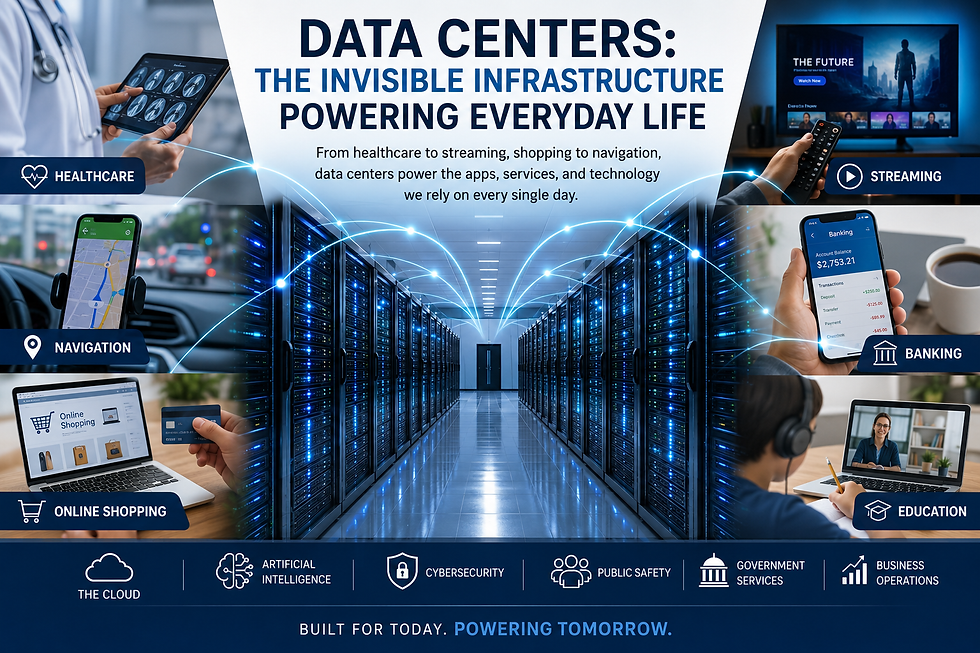
You can't see them from your phone, your laptop, or your television. Yet almost every digital action you take depends on one. From the moment you wake up until you go to bed, data centers are quietly working behind the scenes to keep modern life running.
So, what exactly is a data center?
A data center is a highly secure facility filled with powerful computer servers, networking equipment, and storage systems that process, store, and deliver digital information. Think of it as the backbone of the internet—the place where your digital world actually lives.
Without data centers, many of the services we rely on every day simply wouldn't exist.
Healthcare Depends on Data Centers
When you visit a hospital or doctor's office, your electronic medical records are securely stored and accessed through data center infrastructure. Doctors can review X-rays, MRI scans, lab results, prescriptions, and patient histories within seconds because of secure computing facilities that operate around the clock.
Emergency rooms, telemedicine appointments, medical research, and even many life-saving medical devices rely on this digital infrastructure.
Every GPS Route Starts in a Data Center
When you open Google Maps or Apple Maps to find the fastest route home, you're not just using your phone. Your device communicates with massive computing systems that analyze millions of pieces of real-time traffic data every second.
Accidents, road closures, weather, and traffic conditions are constantly processed so your navigation app can guide you efficiently.
Online Shopping Wouldn't Exist Without Them
Whether you're ordering groceries, buying clothes, or purchasing a birthday gift, every online transaction depends on data centers.
Inventory management, payment processing, shipping updates, fraud prevention, customer accounts, and order tracking all happen through cloud infrastructure hosted inside data centers.
Streaming Your Favorite Shows
Netflix, YouTube, Spotify, Disney+, Hulu, and nearly every streaming platform rely on data centers to deliver movies, music, and live events instantly.
When millions of people watch the same sporting event or new movie release at the same time, enormous computing power is working behind the scenes to make that experience seamless.
Banking and Financial Security
Checking your bank balance, depositing a check from your phone, using a debit card, transferring money, or investing online all depend on secure data centers.
Financial institutions operate some of the most secure digital infrastructure in the world to protect customer information while processing millions of transactions every day.
Education Has Gone Digital
Students now attend virtual classrooms, submit homework online, access digital textbooks, and collaborate with classmates from anywhere in the world.
Schools, universities, and research institutions depend on data centers to keep learning accessible and secure.
Public Safety and Emergency Services
911 dispatch centers, emergency communications, weather forecasting, disaster response systems, and many government services rely on data centers operating continuously.
When emergencies happen, reliable digital infrastructure helps first responders receive critical information quickly.
Artificial Intelligence Lives in Data Centers
Every time someone asks an AI assistant a question, generates an image, translates a language, or uses advanced search tools, thousands of powerful processors inside data centers are performing complex calculations in seconds.
Artificial intelligence isn't replacing data centers—it depends on them.
The Cloud Isn't Floating in the Sky
People often talk about "the cloud," but the cloud is actually thousands of interconnected data centers located around the world.
Your emails, photos, documents, business files, family videos, and backups are stored safely inside these facilities—not floating somewhere in space.
Building the Future Responsibly
As demand for AI, healthcare, cybersecurity, cloud computing, and digital services continues to grow, so does the need for modern data centers.
Today's facilities are becoming more efficient than ever before. New technologies such as liquid cooling, advanced power management, renewable energy integration, and brownfield redevelopment are helping reduce environmental impacts while delivering the computing power our society depends on.
At A1 Data Center, we believe the conversation shouldn't be about whether data centers are necessary—they already are. The real conversation is how to build them responsibly, efficiently, and in ways that strengthen local communities while supporting the digital economy.
Because every text message, every online purchase, every medical record, every GPS route, every streamed movie, and every AI conversation begins in a data center.
Most people never see one.
But everyone depends on one.
Verified Sources
U.S. Department of Energy – Data Centers and Servers
https://www.energy.gov/cmei/buildings/data-centers-and-servers
General information: buildings@ee.doe.gov
Uptime Institute – Global Data Center Survey 2024
Research contact: research@uptimeinstitute.com
Microsoft – How Data Centers Power Everyday Necessities
Microsoft Media Relations: msrinfo@microsoft.com
World Resources Institute – 7 Ways Data Centers Affect U.S. Communities
https://www.wri.org/insights/us-data-center-growth-impacts
General contact: contact@wri.org


Comments