
Data Centers: The Invisible Backbone of Our Digital World

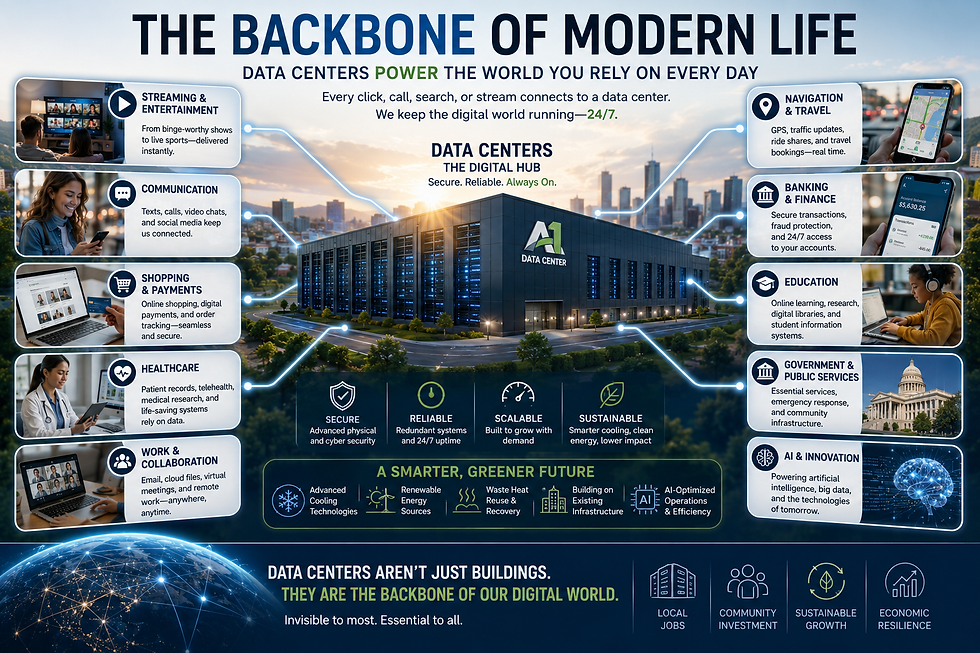
Why the future of data centers is smarter, greener, and more important than ever.
Most people don't think about data centers.
Yet nearly every moment of modern life depends on one.
When you ask your phone for directions, stream Netflix, pay with a credit card, schedule a doctor's appointment, upload family photos, use ChatGPT, shop on Amazon, join a Zoom meeting, or even send a simple text message—you're relying on data centers working behind the scenes.
Without them, the digital world simply wouldn't exist.
The truth is that data centers aren't just warehouses full of computers.
They're the infrastructure powering our economy, healthcare, education, banking, government, entertainment, artificial intelligence, and nearly every online service we use every day.
The Internet Has a Physical Home
Many people imagine "the cloud" as something floating somewhere in cyberspace.
In reality, the cloud lives inside physical buildings filled with servers, networking equipment, storage systems, cooling infrastructure, and electrical equipment.
Every Google search.
Every online purchase.
Every AI prompt.
Every banking transaction.
Every streaming movie.
Every social media post.
Every GPS route.
It all passes through data centers.
Think of data centers like airports.
You may never think about them while traveling, but without airports, airplanes couldn't connect the world.
Likewise, without data centers, the internet would simply stop functioning.
More Than Just Storage
A common misconception is that data centers simply "store data."
Today's facilities do much more.
Modern data centers:
Process billions of internet requests every day
Power artificial intelligence and machine learning
Support hospitals and emergency services
Protect financial transactions
Operate cloud computing platforms
Deliver streaming video worldwide
Run enterprise software
Enable remote work
Connect billions of mobile devices
Support national security and government operations
They're essentially the digital equivalent of highways, power plants, and water systems—critical infrastructure that society depends upon.
Why Demand Is Growing So Quickly
Artificial intelligence has dramatically increased the need for computing power.
Training advanced AI models requires enormous amounts of processing capability.
At the same time, the world continues generating unprecedented amounts of digital information.
According to the International Energy Agency, internet traffic has grown roughly 25-fold since 2010, while the number of internet users has more than doubled. Despite this explosive growth, improvements in hardware efficiency and facility design have helped keep electricity demand from rising at the same pace.
The future isn't simply about building more data centers.
It's about building better ones.
Changing the Narrative: Today's Data Centers Are Different
Data centers have often been criticized for their electricity use.
That's a fair conversation.
But it's only part of the story.
The industry has evolved dramatically over the past decade.
Today's leading facilities are becoming significantly more efficient through innovations in nearly every aspect of their design.
Advanced Cooling Technologies
Cooling has traditionally been one of the largest energy consumers inside a data center.
New technologies include:
Direct-to-chip liquid cooling
Immersion cooling
AI-optimized cooling controls
Free-air cooling in suitable climates
Heat recovery systems
According to the IEA, cooling systems account for roughly 7% of electricity use in highly efficient hyperscale facilities, compared with over 30% in older, less-efficient enterprise data centers, demonstrating how much progress has already been made.
Artificial Intelligence Is Improving Data Centers Too
Ironically, AI isn't just increasing demand.
It's also helping solve efficiency challenges.
Machine learning now helps operators:
Predict equipment failures
Optimize cooling in real time
Reduce unnecessary power consumption
Improve maintenance schedules
Balance workloads across servers
Increase reliability
Smarter operations mean lower operating costs and lower environmental impact.
Renewable Energy and Cleaner Power
Many of the world's largest technology companies are investing heavily in renewable energy and cleaner electricity sources to power their infrastructure.
The industry is exploring:
Solar
Wind
Nuclear
Battery storage
Natural gas with higher efficiency
Waste heat recovery
Microgrids
Demand-response technologies
The U.S. Department of Energy also highlights flexible grid technologies and virtual power plants as important tools for integrating future data center growth while improving grid efficiency.
Reusing What Was Once Wasted
One of the most exciting developments is waste heat recovery.
Instead of simply exhausting warm air outside, some modern facilities capture excess heat and use it to warm nearby buildings, district heating systems, greenhouses, or industrial processes.
Researchers continue identifying new opportunities to transform what was once considered waste into valuable energy.
Building on Existing Industrial Land
Another important trend is where facilities are built.
Rather than developing untouched land, many projects are redeveloping:
Former manufacturing facilities
Brownfield sites
Retired industrial campuses
Existing power infrastructure
Redevelopment can reduce environmental impacts while bringing new investment and jobs to communities with existing utility infrastructure.
Efficiency Is Measured
Modern operators closely monitor performance using metrics like Power Usage Effectiveness (PUE)—a measure of how efficiently a facility delivers electricity to computing equipment rather than supporting infrastructure like cooling and lighting.
The closer a PUE is to 1.0, the more efficient the facility.
According to the Uptime Institute, the global average PUE continues to improve as operators modernize facilities and adopt new technologies.
A Balanced Conversation
None of this means data centers have no environmental impact.
Large facilities require electricity, cooling, and—in some designs—water.
These are legitimate considerations.
The industry's challenge isn't to ignore those realities.
It's to continuously improve.
Governments, utilities, technology companies, engineers, and developers are increasingly focused on:
Better energy efficiency
Cleaner electricity
Reduced water consumption
Greater transparency
More sustainable construction
Smarter cooling technologies
The conversation has shifted from "Should we build data centers?" to "How do we build them responsibly?"
The Infrastructure Behind Everything
Data centers rarely receive the recognition they deserve because they're designed to be invisible.
When they do their job well, nobody notices.
But behind every search engine, every online classroom, every hospital record, every banking transaction, every emergency response system, every streaming service, and every AI breakthrough is an enormous amount of digital infrastructure working around the clock.
The future of artificial intelligence, cloud computing, healthcare, finance, manufacturing, scientific research, and global connectivity depends on these facilities.
As technology continues to evolve, so will data centers.
They are becoming more efficient.
More intelligent.
More sustainable.
And more essential than ever before.
Rather than viewing them simply as buildings full of servers, we should recognize them for what they truly are:
The digital backbone of modern civilization.
Sources
International Energy Agency – Data Centres and Data Transmission Networks: https://www.iea.org/energy-system/buildings/data-centres-and-data-transmission-networks
International Energy Agency – Energy Demand from AI: https://www.iea.org/reports/energy-and-ai/energy-demand-from-ai
U.S. Department of Energy – Clean Energy Resources to Meet Data Center Electricity Demand: https://www.energy.gov/oe/clean-energy-resources-meet-data-center-electricity-demand
Uptime Institute – Global Data Center Survey 2025: https://uptimeinstitute.com/resources/research-and-reports/uptime-institute-global-data-center-survey-results-2025
American Council for an Energy-Efficient Economy (ACEEE) – Data Center Energy Efficiency: https://www.aceee.org/sites/default/files/pdfs/opportunities_to_use_energy_efficiency_and_demand_flexibility_to_reduce_data_center_energy_use_and_peak_demand.pdf
Renewable & Sustainable Energy Reviews – Data Center Waste Heat Recovery: https://www.sciencedirect.com/science/article/pii/S1364032125005362


https://soicaulodechuan.mobi/du-doan-so-de-hom-nay mình thấy bài này có mục lục đánh số nên đọc lướt cũng tiện ghê. Thường gặp bài dài là mình hơi lười, chỉ muốn biết có những phần gì trước rồi mới đọc tiếp, chứ kéo mãi mà chưa gặp đoạn cần tìm thì dễ bỏ ngang lắm. Ở đây nhìn tên mục là hình dung được thứ tự nội dung, không phải dò từng đoạn. Mình chưa xem kỹ phần dự đoán nên không nói chuyện đúng sai của các con số nhé. Có để ý là bài cho xem kết quả miền Bắc hôm qua rồi mới tới phần dự đoán hôm nay, cách đặt vậy đọc thấy liền mạch hơn. Riêng trong mục lục, phần…
Bài bạn viết ngắn gọn mà dễ hiểu thật, mình đọc liền một lượt là nắm được ý, cảm ơn bạn đã chia sẻ. Mình cũng có thói quen xem thống kê XSMB mỗi ngày để tiện nhìn nhanh, nhưng hồi trước toàn phải mở vài nơi khác nhau rồi tự so sánh nên khá mất công. Về sau mình gom lại cho gọn, lưu trên một trang ở soicau247.com để khi cần chỉ vào xem lại cho nhanh, khỏi phải lục tìm. Mình chỉ cần dữ liệu cập nhật theo ngày để theo dõi xu hướng chung thôi, không làm gì phức tạp hay tính toán nhiều. Nếu bạn cũng xem kiểu đơn giản như vậy thì có thể…
Mình xem xổ số kiểu cho vui là chính, coi như một thú giải trí nhẹ nhàng nên không đặt nặng chuyện phải trúng. Trước đây nghe người ta bàn về “cầu kèo” các thứ mình cũng tò mò lắm, nhưng thật sự mù mờ. Theo dõi lâu hơn thì đôi lúc thấy có vài dạng số lặp lại làm mình chú ý hơn, dù vậy vẫn tự nhắc phải tỉnh táo. Thỉnh thoảng mình đọc mấy bài nhận định rồi ghi vội vài ý, sau đó đối chiếu kết quả để xem có phải mình đang tự ám thị không. Có bữa trúng chút thì vui, có bữa lệch hết nên càng không dám tin tuyệt đối. Mình hay…