
Community Benefit Agreements: The Missing Piece in Responsible Data Center Development

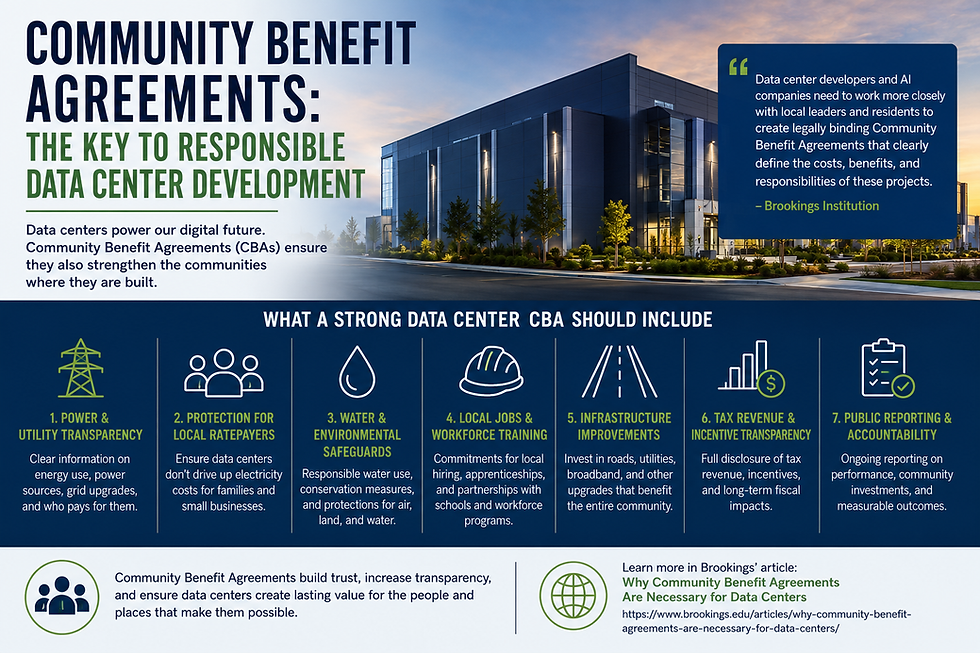
Why Community Benefit Agreements for Data Centers Matter. What Community Benefit Agreements for Data Centers Should Include.
Data centers are becoming one of the most important pieces of modern infrastructure. They power artificial intelligence, cloud computing, banking systems, hospitals, e-commerce, streaming platforms, cybersecurity, and nearly every digital service people use every day.
But as data centers become larger and more energy-intensive, communities are asking serious and reasonable questions:
Who benefits from these projects?
Who pays for the infrastructure upgrades?
Will local residents see higher utility costs?
How much water will be used?
How many permanent jobs will actually be created?
What protections will be in place for the surrounding community?
A recent Brookings article, “Why Community Benefit Agreements Are Necessary for Data Centers,” explains why these questions cannot be ignored. Brookings argues that data center developers and AI companies need to work more closely with local leaders and residents to create legally binding Community Benefit Agreements, also known as CBAs, that clearly define the costs, benefits, responsibilities, and long-term community protections tied to data center development.
What Is a Community Benefit Agreement?
A Community Benefit Agreement is a formal agreement between a developer and a host community. It outlines what the project will provide to the local area in exchange for the ability to build and operate there.
For data centers, a strong CBA can include commitments related to local hiring, tax revenue, infrastructure improvements, workforce training, environmental protection, energy transparency, water usage, noise mitigation, emergency planning, and ongoing public reporting.
Brookings describes CBAs as a way to create transparency and reciprocity between data center developers and the communities where these facilities are located. The article emphasizes that communities need to understand the true cost of data centers, who pays for those costs, what benefits are being promised, and what happens as AI infrastructure continues to grow.
Why This Matters for Data Center Development
The demand for data centers is growing quickly because of artificial intelligence and cloud computing. However, that growth also brings pressure on local infrastructure.
Large-scale data centers can require significant electricity, backup power systems, water resources, fiber connectivity, land, road access, and utility upgrades. Without transparency, residents may worry that they are taking on the burden while private companies receive most of the benefit.
Brookings notes that public concerns around data centers often include electricity costs, water use, environmental impact, local job creation, and whether the community will receive meaningful long-term benefits.
These concerns are not anti-technology. They are about fairness, planning, and accountability.
Communities are not necessarily opposed to data centers. Many communities want economic development, tax revenue, and new investment. But they want to know that the project is being developed responsibly and that local residents will not be left out of the conversation.
What a Strong Data Center CBA Should Include
A well-written Community Benefit Agreement should be specific, measurable, and enforceable. It should not be a vague promise or a marketing statement.
For data centers, important areas may include:
1. Power and Utility Transparency
Because power is one of the most important parts of any data center project, communities should understand how much electricity the project will use, where that power will come from, whether grid upgrades are needed, and who will pay for those upgrades.
This is especially important as AI data centers create increasing demand for high-capacity power infrastructure.
2. Protection for Local Ratepayers
One of the biggest community concerns is whether large data center power demand could contribute to higher utility costs for residents and small businesses.
A CBA can help address this by requiring transparency around utility costs, infrastructure investment, and whether the developer is responsible for project-specific upgrades.
3. Water Usage and Environmental Safeguards
Some data centers use water for cooling, while others use low-water or closed-loop systems. Communities should know how much water will be used, where it will come from, how it will be managed, and what conservation measures will be in place.
Environmental safeguards should also address stormwater, backup generators, emissions, noise, and long-term site management.
4. Local Jobs and Workforce Training
Data centers can create major construction jobs, but the number of long-term permanent jobs may be more limited. A CBA should clearly identify expected construction jobs, permanent jobs, local hiring goals, apprenticeship programs, and workforce partnerships.
Brookings specifically recommends that CBAs include quantifiable data on job opportunities, workforce training programs, tax revenue, and other community benefits.
5. Infrastructure Improvements
Data centers often require upgrades to substations, transmission lines, fiber networks, roads, water systems, sewer systems, or stormwater infrastructure. A strong agreement should explain what improvements are needed, who pays for them, and whether those improvements will benefit the broader community.
6. Tax Revenue and Incentive Transparency
Many data center projects involve tax incentives, abatements, or negotiated economic development agreements. Communities deserve a clear understanding of projected tax revenue, the value of any incentives, and the long-term fiscal impact of the project.
Brookings also notes that community leaders should evaluate both local benefits and risks so they can make informed decisions about data center proposals.
7. Public Reporting and Accountability
The most important part of any CBA is accountability. A strong agreement should include regular reporting on energy usage, water usage, job creation, tax payments, environmental performance, and community investments.
Brookings recommends metric tracking and rigorous evaluation programs so that communities can better understand how data centers affect local areas over time.
Community Trust Is Now Part of the Development Process
The data center industry is changing. It is no longer enough to have land, power, fiber, and capital. Developers also need community trust.
A project that does not engage the community early can face delays, opposition, political pushback, and reputational risk. A project that is transparent from the beginning has a better chance of building support and moving forward responsibly.
Brookings also hosted a 2026 discussion on how Community Benefit Agreements can help mitigate public concerns about data centers, noting that communities across the country are looking for greater transparency and support around digital access, employment, health, well-being, and local impacts.
This shows that CBAs are becoming more than a policy idea. They are becoming a practical tool for communities and developers to work together.
Responsible Data Centers Can Create Long-Term Value
Data centers are essential to the future of AI, cloud computing, and digital infrastructure. But the next generation of data centers must be developed with more transparency and stronger local partnerships.
Community Benefit Agreements can help create that framework.
They give residents a voice. They give local governments measurable commitments. They give developers a clearer path to community acceptance. They help ensure that major infrastructure projects create real, lasting value for the places where they are built.
The future of data centers should not be about choosing between technology and community. It should be about building both together.
When data centers are planned responsibly, they can support innovation, strengthen local infrastructure, generate tax revenue, create workforce opportunities, and help communities participate in the digital economy.
But that only happens when developers are willing to listen, engage, and commit.
Community Benefit Agreements are not just necessary for data centers. They may become one of the most important tools for building the future of digital infrastructure responsibly.
References
Brookings Institution — “Why Community Benefit Agreements Are Necessary for Data Centers”https://www.brookings.edu/articles/why-community-benefit-agreements-are-necessary-for-data-centers/
Brookings Institution — “How Community Benefit Agreements Can Mitigate Public Concerns About Data Centers”https://www.brookings.edu/events/how-community-benefit-agreements-can-mitigate-public-concerns-about-data-centers/



Comments