
The Future of Data Centers: Why Power, Cooling, and Smarter Infrastructure Will Define the AI Era

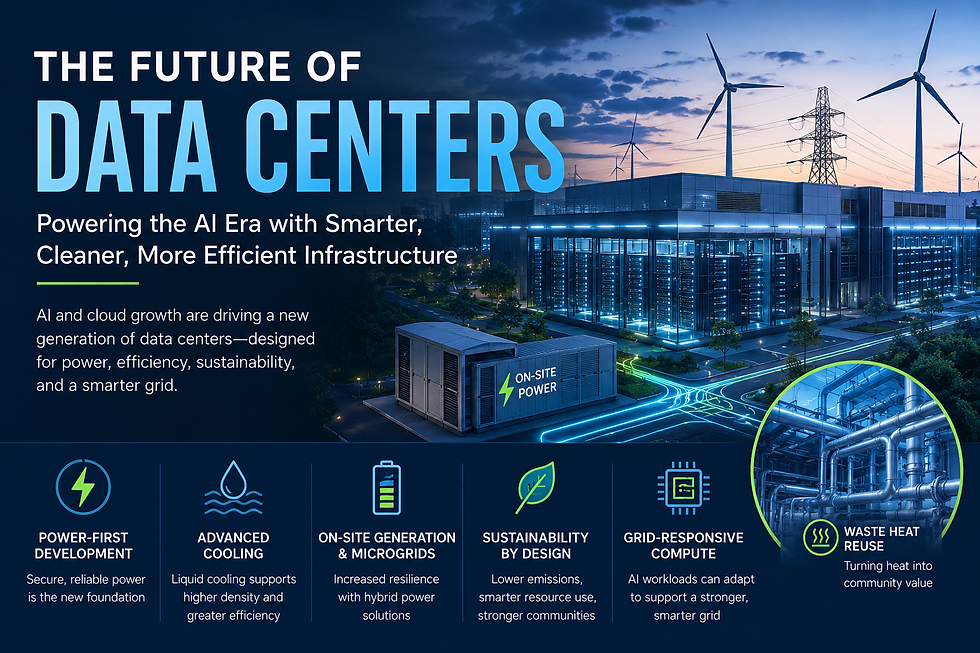
The Future of Data Centers: Powering the AI Era
Artificial intelligence is changing the world, but behind every AI model, cloud platform, streaming service, financial transaction, and digital tool is a physical infrastructure system most people rarely think about: the data center.
For years, data centers were viewed mainly as technology real estate. Companies needed land, fiber, buildings, servers, and security. Today, that picture has changed. The next generation of data centers is not just about square footage or server racks. It is about power availability, grid reliability, cooling innovation, energy efficiency, and the ability to deliver massive amounts of electricity exactly where and when it is needed.
The AI boom has made one thing clear: data centers are becoming some of the most important infrastructure assets in the modern economy.
AI Is Driving a New Era of Electricity Demand
The demand for data center power is rising quickly. According to the International Energy Agency, global data center electricity consumption is expected to more than double by 2030, reaching around 945 terawatt-hours. That is slightly more than Japan’s total electricity consumption today. The IEA also notes that the United States accounts for the largest share of projected growth, with data centers representing nearly half of U.S. electricity demand growth between now and 2030.
In the United States, the Department of Energy and Lawrence Berkeley National Laboratory reported that data centers used about 176 terawatt-hours of electricity in 2023, or roughly 4.4% of total U.S. electricity consumption. By 2028, that figure could rise to between 325 and 580 terawatt-hours, representing 6.7% to 12% of total U.S. electricity use.
The trend is already showing up in national energy forecasts. The U.S. Energy Information Administration expects electricity consumption to reach new record highs in both 2026 and 2027, driven by data centers, artificial intelligence, cryptocurrency, manufacturing, and broader electrification.
This growth creates an opportunity, but it also creates a major challenge. The issue is no longer only whether companies can build enough data center space. The bigger question is whether enough power can be delivered reliably to support the next wave of AI infrastructure.
The New Bottleneck: Deliverable Power
Data centers do not just need electricity. They need reliable, high-capacity, redundant electricity.
That distinction matters. A project may be located near a power line, but that does not always mean the grid can deliver hundreds of megawatts on the timeline the market needs. Utilities may need new substations, transformers, switchgear, transmission upgrades, interconnection studies, and years of planning before a large load can be served.
This is why the data center industry is shifting from a “buildings-first” model to a “power-first” model. The most valuable sites are increasingly those that already have access to substations, transmission, natural gas, fiber, water, and the ability to support either grid power, on-site generation, or a hybrid energy strategy.
Recent investment activity reflects this shift. American Electric Power’s Texas unit secured up to $3.26 billion in federal loan support to expand transmission capacity, including new high-voltage infrastructure, partly in response to rising demand from data centers, AI, electrification, and industrial growth.
Meta’s newly announced C$13 billion data center project in Alberta is another example. The planned one-gigawatt facility is expected to rely on major new power infrastructure, including a natural gas-fired generation project being developed to support the campus.
These examples show where the market is headed: the future data center is not simply connected to the power grid. It is increasingly designed around power strategy from day one.
Liquid Cooling Is Becoming Essential
Power is only one side of the equation. The other is heat.
AI workloads require dense, high-performance computing environments. As racks become more powerful, traditional air-cooling systems are being pushed to their limits. This is why liquid cooling is quickly becoming one of the most important technologies in next-generation data center design.
Liquid cooling can remove heat more efficiently than air cooling, especially in high-density AI environments. Technologies such as direct-to-chip cooling, rear-door heat exchangers, and immersion cooling allow operators to support more compute power per rack while reducing stress on mechanical cooling systems.
The liquid cooling market is expected to grow significantly as AI, cloud computing, and edge computing expand. Market research projects the global data center liquid cooling market could grow from about $4.07 billion in 2026 to $27.65 billion by 2033.
For communities and developers, this matters because cooling design affects energy consumption, water usage, operating costs, and environmental impact. The most competitive data centers will not only secure power; they will use that power more efficiently.
Waste Heat Could Become a Community Asset
One of the most promising ideas in data center sustainability is waste heat reuse.
Data centers generate enormous amounts of heat. Historically, that heat was treated as a problem to be removed. Newer approaches treat it as a resource that can potentially support nearby buildings, district heating systems, greenhouses, industrial processes, or thermal energy networks.
The Environmental and Energy Study Institute has highlighted how thermal energy networks can capture waste heat from data centers and distribute it through underground water pipes with utility-scale heat pumps. This can help reduce heating costs for nearby buildings and lower the environmental impact of cooling.
A 2025 review of data center waste heat for district heating networks also found growing global interest in recovering and reusing data center heat from technical, economic, and environmental perspectives.
This is where the public conversation around data centers needs to evolve. Instead of asking only, “How much power will this facility use?” communities should also ask, “How can this facility be designed to create infrastructure benefits?”
A well-planned data center campus can potentially support grid investment, tax revenue, fiber expansion, energy modernization, job creation, and even local heat reuse. Poorly planned projects, on the other hand, can strain utilities and create public resistance.
On-Site Generation and Microgrids Are Moving Into the Mainstream
As grid interconnection timelines become longer, more operators are evaluating on-site power generation. This includes natural gas turbines, fuel cells, battery storage, solar, wind, geothermal, and even advanced nuclear concepts.
Behind-the-meter power systems allow data centers to reduce dependency on constrained grids and improve resilience. These systems can also be paired with microgrids, allowing a campus to manage local generation, storage, backup power, and grid interaction more intelligently.
CoreSite has described behind-the-meter systems such as gas turbines, fuel cells, modular nuclear reactors, solar, and wind as a way for data centers to improve scalability, flexibility, and reliability as power demand rises.
This does not mean every data center will operate independently from the grid. More likely, the future will be hybrid. The strongest projects will combine utility power, on-site generation, storage, and intelligent load management. This gives operators more flexibility while giving utilities a better way to plan around large new loads.
Data Centers Could Become Grid-Responsive Assets
A major emerging technology trend is the idea of power-flexible data centers.
Traditionally, utilities viewed large data centers as inflexible power loads. They needed electricity continuously, and the grid had to serve them. New research suggests that AI data centers may be able to operate more dynamically.
A 2026 paper on power-flexible AI data centers describes how GPU-based facilities can respond to grid conditions through workload scheduling, power telemetry, and software-based orchestration. In simple terms, certain AI workloads can be shifted, delayed, or moved between regions when the grid is stressed, while priority services remain protected.
Another 2026 research paper explores carbon-aware compute and power scheduling, where AI data centers coordinate workloads, local generation, battery storage, grid interaction, and emissions goals.
This could be a major turning point. Instead of being viewed only as large electricity consumers, advanced data centers could become flexible grid participants. They may help reduce peak strain, absorb renewable energy when it is available, and shift certain workloads to cleaner or less congested regions.
The Future Data Center Will Be Measured Differently
For years, the industry focused heavily on PUE, or Power Usage Effectiveness. PUE remains important, but it does not tell the whole story anymore.
The next generation of data center evaluation will likely include broader questions:
How quickly can the site receive power?
Is the power redundant?
Can the campus support on-site generation?
Can it integrate renewable energy, batteries, fuel cells, or turbines?
Does the cooling system reduce water and energy waste?
Can waste heat be reused?
Can AI workloads respond to grid conditions?
Does the project create benefits for the surrounding community?
This broader approach is important because data centers are now directly tied to national competitiveness, energy security, economic development, and climate strategy.
Data Centers Are the Backbone of the Digital Economy
Every industry now depends on digital infrastructure. Healthcare, banking, logistics, real estate, education, manufacturing, entertainment, government services, and artificial intelligence all rely on data centers.
As AI adoption accelerates, the need for secure, efficient, power-ready infrastructure will only grow. The winners in this new market will be the projects that understand data centers as more than buildings. They are energy platforms, compute hubs, and critical infrastructure assets.
The next wave of development will favor sites that can solve the biggest problems facing the industry: power availability, cooling efficiency, grid reliability, and environmental responsibility.
The future of data centers is not just bigger. It is smarter, more energy-aware, more integrated with the grid, and more important to the economy than ever before.
As the AI era expands, data centers will continue to serve as the physical foundation of our digital world. The communities and companies that plan for this now will be better positioned to benefit from the infrastructure transformation already underway.


Comments